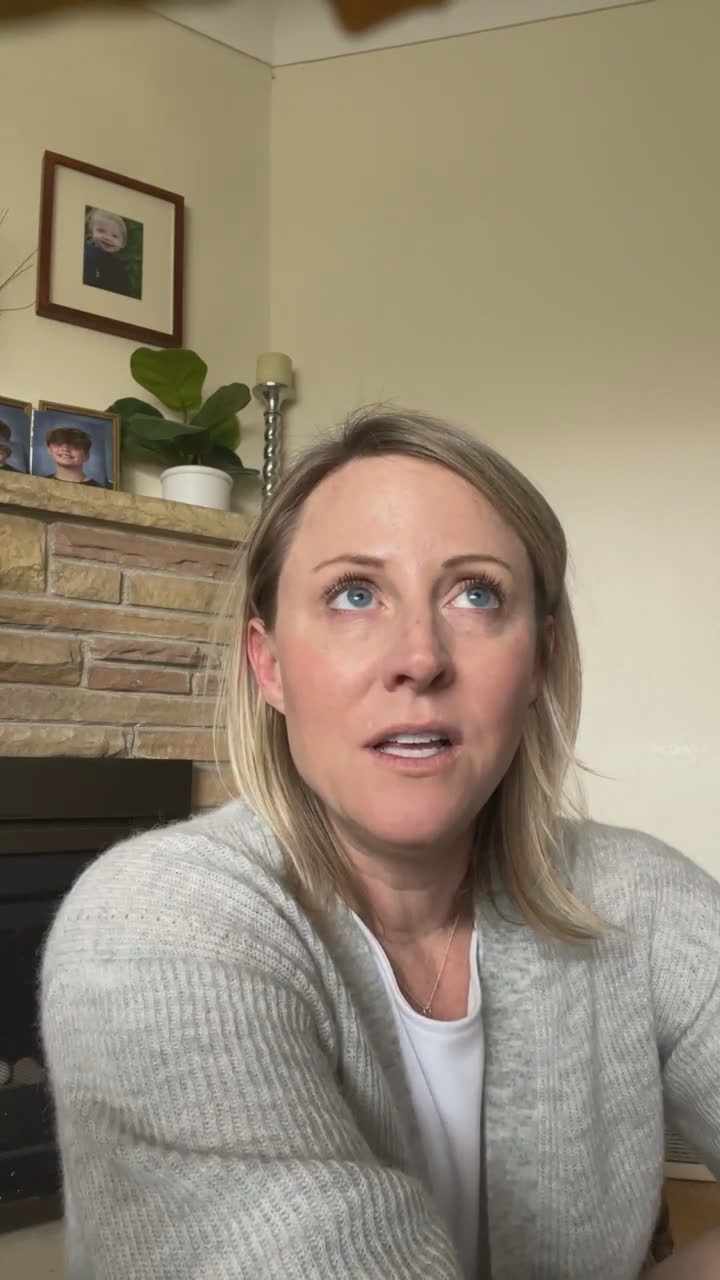
Today I’ll share the skills learned in therapy to cope with the grief and loss of family connection.
Hi, Cadre. Happy Friday. I am a couple minutes late. Welcome to things we are supposed to talk about, family estrangement version. So I'm going to give you guys a couple of minutes to join.
Today is grief day on Cadre. Shannon is talking about navigating and managing family relationships that were very unhealthy. Here are five steps she took to cope with that and grieve it and move forward in a healthy way.
If you're struggling with a relationship in your life, I invite you to notice that you feel something different. And I know this is grief day on Cadre, and grief is a huge part of this, navigating these family systems. And there isn't a wrong way.
Jocelyn: My first step for you today, on grief day, is to know that you're not alone. She says you were born to be you, period. And guess what else? Every other person in your family was also born perfectly them. As you go into this weekend, remember that you are born exactly the way you are.
Hi, Cadre. Happy Friday. It is. Shannon here. I am a couple minutes late. Welcome to things we are supposed to talk about, family estrangement version. So I'm going to give you guys a couple of minutes to join. So, yeah, today is grief day on Cadre, and so we are talking about all different kinds of grief. And one of the things I love about grief day on Cadre is that that manifests in so many different ways. Not because I love the manifestation of grief, obviously, but because I love that we talk about all the true things that we can grieve for in life as humans.
Okay, so, today, I'll introduce myself. For those of you who don't know me again, my name is Shannon. I am here on Cadre as not a clinician, not a mental health professional, no one with any credentials other than a lived experience of someone dealing with a lot of things in life. So, I have generalized anxiety disorder. I parent a child with autism, and I have cpTSd. So what is CPTSD? CPTSD is actually probably most connected to what I'm gonna talk about today. And CPTSD is, excuse me, is a complex post traumatic disorder.
So PTSD, but really connected for me to my familial relationships growing up. So that is what I'm gonna talk about today. I said last week that there's some things I learned in therapy, and I've been in therapy for eight years, that have helped me with, particularly my family estrangement. But I'm going to say, I think sometimes that word family estrangement makes people feel funny. It's super intense, right? Like, who in the world goes out and says, like, hey, do you want to talk about family estrangement?
Right? It's just truly, honestly, it's, like, a really horrible word, and it's laden with a lot of meaning and just, like, shame, right? Like, it's a big word. So I think I'm gonna reframe this series as I talk about the things that I learned in therapy. And they're, you know, I've called them down to five steps. It's sort of like how I worked through all the things that were hard for me with my family system. So I'm gonna tell you a really abbreviated version of what my story is, and then I'm gonna tell you the first step in the actions that I took to start to cope with that and grieve it and move forward in a healthy way.
So I'll give you the long and the short of it. I grew up in a very religious family, sort of a traumatic religious family. There were many divorces in my family, many multiple parents, lots of things that I have had step siblings, I have had sexual abuse, physical abuse in my family system. Just a lot of loss and really living in a place of hyper vigilance for a really long time. So all of that to say, the way that I responded to that was really through perfectionism and control. So if any of you grew up in a way in which you were sort of always on guard and hyper vigilant, you know, that you try to control stuff to feel better.
So I did all of that, and I got married, and I did all the right things. And I had beautiful children, I bought a house, and it was successful. And all the things on paper that look exactly right. And then at 40, I kind of had a little bit of a breakdown. And I realized that I was not living true to what I felt inside. My inside and my outside were not aligned. And a huge part of that for me was navigating and managing family relationships that were very unhealthy. And I was just too afraid to say it because if I said it, then I would have to do something about it.
And I did. And so my first step in all that I learned from therapy was to know that something's not right. So what does that mean? It means for me, at 40, I, again, I just told you, I was married. I had this very stable life, but I knew that it was grounded in things that weren't true for me. And so I said it out loud. I said it out loud to my husband at the time. I said, this isn't working for me. I'm not authentically living as who I am. And it blew up my life. And at the same time, again, going to step one of what I learned in therapy, I knew it wasn't right.
I think often for us, as we live in family systems, as we live in cultural systems, of expectations, of the roles we take on, there's a right way. And I was trying desperately to be right in my relationship with my mother and my father and my siblings and all the things I was trying to show up in all the right ways. And the truth of it was, is that what was right for me was different than what is right in my family system. And so that in and of itself, was a huge step to knowing that I had to do something.
So my invitation to you, if you're someone who is struggling with a relationship in your life, whether that is a family member, whether that is a child, whether that is a sibling, whether that is a spouse, really anyone in your life where you feel stuck in a system that isn't working for you, I think I invite you to notice that you feel something different and to know that this isn't working. And I know this is grief day on Cadre, and grief is a huge part of this, navigating these family systems, because you're pushing against what your family has said is good and right.
And if it doesn't feel good and right to you, and you know that's true, there's grief in that, and that is really hard. And I'm going to talk more in the coming weeks about the other steps, but I think that process of knowing it, sitting in it and just sitting with yourself and trying it on for size almost, of, hey, is this me? Is this belief system me? Is this life me? Are the words I'm speaking and the thoughts in my head, are they different? Are they wildly different? And there isn't a wrong way.
And that is really freaking hard because it might feel like there will be a wrong way. So my first step for you today, on grief day, and actually, I want to reframe that. It's not a step for you. It was a step for me. And I'm saying it so that you know you're not alone. Should you notice that something isn't working for you, is to know that you're not alone in that there's nothing wrong with you for feeling what you feel. I think one of the biggest things that I have learned in my therapy, from my therapist was that we are all born exactly knowing exactly what we need.
And I think that's true. That's my personal belief system. I believe we were born whole. I believe we learn how to navigate the world as a part of all the things that come at us and we're exposed to and who we are inside. And so my voice to you today and my words to you today is that who you are inside, however that fits within your family system, however that fits within the role that you're in in your life, is exactly, perfectly right, because you were born to be you, period. And guess what else?
Every other person in your family was also born to be perfectly them. And so this isn't an us or them situation. This isn't a I'm right, you're wrong. This is a how can you find the space? How can I find the space to honor who each of us are individually and know that it's okay if those two things aren't the same? So that's lesson one, friends. I'm going to call it lesson one. But it's the first thing that I learned was just to know that that was a thing. And that was the first step on my journey to be able to find some peace.
And it's eight years later, and I can tell you I'm happier than I've ever been. I can also tell you that my ex husband, who I said that out loud to, who I did, divorce. We have talked about how both of us are happier now than we ever were because we're both being true to who we are. And I know that's not always the case, but for me, it was. And so I'm grateful for that every day. So, as you go into this weekend, if you're dealing with things that feel hard, if you're dealing with things that feel like you're wrong, you're not.
You're. You. You're beautiful. We are here. There are so many people going through this. I can tell you that from my lived experience. It's just that we don't talk about it that much. So you're not alone. Jocelyn, I'm glad you're here. Thank you for being here. A big heart to you, too. And we'll be here next week and again. Go into this week. Go into this time. And just remember that you are born exactly the way you are supposed to be. And you're doing a fantastic job being who you are. We'll see you soon, guys.
Reactions and comments are for members. Joining is free and takes a minute.