Whether it be weight stigma, health issues, or dysregulated eating, grief and loss can often be centered around the relationships we have with ourselves. “If My Plate Could Talk” explores the connections between food, weight, health, and trauma and frameworks for understanding the conversations we have with ourselves, thus begging the question: “If my plate could talk, what would it say to me?”
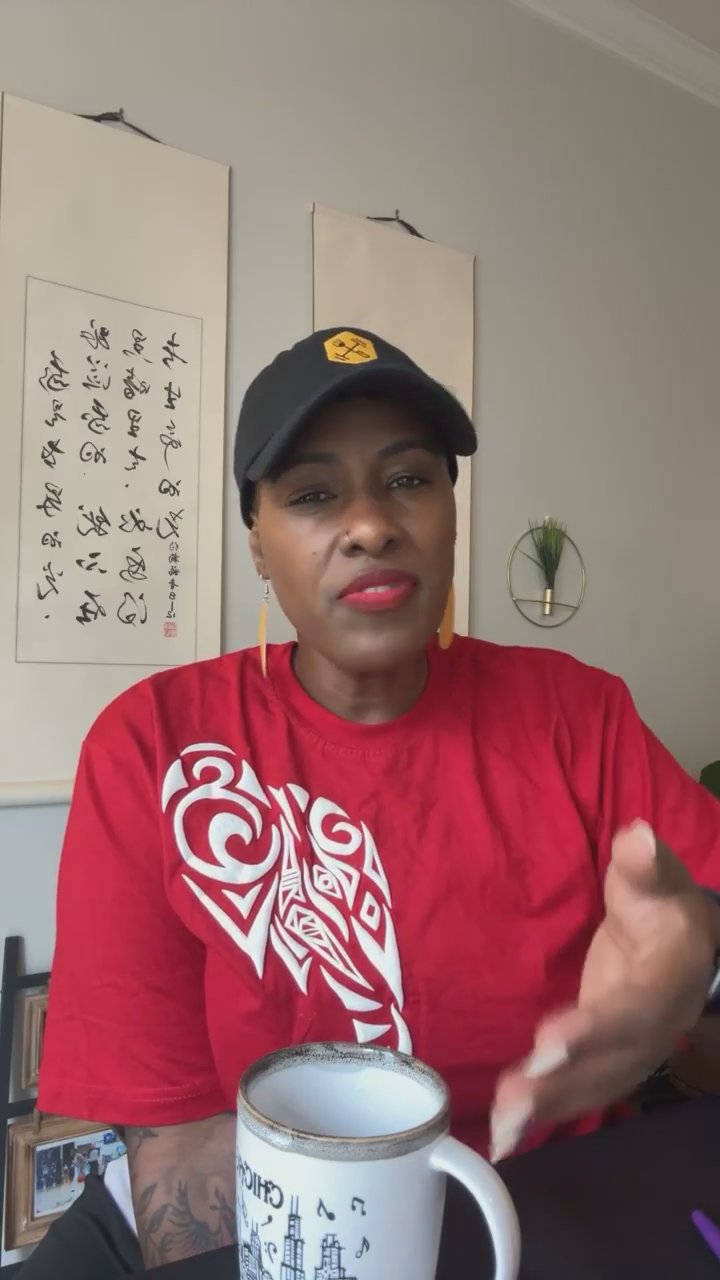
Hello, conscious fear. I'm actually drinking some tea this morning. It's always a game time decision around what goes in this cup, depending upon what I have to do later. Let's see our anchoring point of the day.
On Fridays, we talk about grief. For me, the intersection of grief, trauma, body image, health, all the things. With all of those thoughts in mind, what do you need? It's always something I want you to identify.
Today I want to focus in on Mother's Day and the grief that can subtly or very loudly center around a lot of holidays. Here are a few examples of what different people experience. If I missed something, please add it in the chat so that we can all learn from one another.
Today is a day that we are focusing specifically on that intersection of grief. The whole dynamic and purpose of this all is to know there is space for all of the emotions that we have. Share your truth.
Don't feel the pressure to do anything that you don't want to do. Journal. Share your truth. Because all emotions are messengers. Stay connected to yourself. For those of you that are mothers, I do wish you truly a happy mother's day.
Hello, conscious fear. I hope you are doing well this morning. Cheers. I'm actually drinking some tea this morning. I'll tell you, it's always a game time decision around what goes in this cup, depending upon what I have to do later. But since I know I don't have a ton of time with you today, I wanted to just make sure that I go ahead and, you know, do what I need to do and not pump myself up too much. We'll give everyone a moment to come in. As we do, let's see our anchoring point of the day. I would love to know what you need for the days ahead.
Right. If you're listening to this live, it is a Friday. On Fridays, we talk about grief. And for me, the intersection of grief, trauma, body image, health, all the things. And so with all of those thoughts in mind, what do you need? It's always something I want you to identify. This is your first time here. I'm Doctor Charryse Johnson, a licensed clinical mental health therapist, mindfulness practitioner, and author. But more importantly, I'm your girl. I'm your bfF. I think I'm gonna hold this because that's probably not a good idea.
It's always weird when I'm in a different space, but let me know where you are in the world and let me know what you need. I think that's a question that we don't often ask ourselves or if we do. It's outrageous. But I really want you thinking about what you need and what you need that you can provide for yourself. Today I want to focus in on Mother's Day and the grief that can subtly or very loudly center around a lot of holidays, but in particular around Mother's Day. So a few days ago, I was talking to a client, and some, some of you know that one of my specialties is disordered eating.
And this client is continuing to work on her own ability to listen to the shifts and the changes that she notices when she is just feeling some deep emotion. So she came in and she shared a story with me, and I do have her permission to share the story. And she said, you know, it had been a really great week, and I was going along and everything felt great. And then she noticed that all of a sudden this heaviness just came out of what seemed like nowhere is that something that you have ever experienced where you're like, I really thought I was good.
And then the way she described it was her limbs got heavy, she felt numb and a little withdrawn. She did end up pulling back out of some activities that she had scheduled. But how we got into the conversation was that she also noticed that her eating shifted and became a little bit more erratic than it had been the days before, and she couldn't figure it out. And then it hit her, oh, it's Mother's Day week for her. There's a lot of layers to Mother's Day. Not just even her own relationship with her mother, but her own relationship with her body and what she thought motherhood would look like versus what it does look like.
So it gave us a great opportunity to talk about, well, what do you do when you notice those subtle shifts? And I'm always going to bring up the subtle shifts of food or mood, because those are two things that will always tell you that there's something going on beneath the surface. And yeah, it is a definite freeze response. And for those of you that are unfamiliar, freeze response is when our nervous system really just kind of goes into this hold. You may have also heard me mention at times we can even have what's called a high functioning freeze, which means it's there and we're carrying it, yet we're still going through and doing all of the things that we have to do, but then really struggling to feel connected and to feel joy with them.
So Mother's day can be complicated. Here are just a few examples of what different people experience. You may be one of these people, but if not, this may be helpful because you're going to have people in your life who may fit in one of these categories. And of course, this is not a comprehensive list. So if I missed something, please add it in the chat so that we can all learn from one another. You may be in a season where you have a difficult relationship with your mother, a mother that is still living, but the relationship between the two of you is a situationship.
It's a little complicated. You may have a complicated relationship as a mother. You may not be the kind of mother that you thought you would be, or you may find that your experience with your children is not what you hoped and intended. And you may be in a place where you feel like I thought it would be this way, and it's that way. You may be in a family that cares more about what you do for them than what they do for you. So you may be an unacknowledged mother where you feel like you give and you give and you give, but it's not often returned.
And it's not that you expect it, but it would be nice, but you don't have an opportunity to receive that, and it kind of hurts. You may be someone who grew up with a desire to be a mom, and that hasn't been possible. So you are childless. Maybe that's because you tried. Maybe that's because you didn't and decided you didn't want to. And then you feel like there was this whole holiday, and what if that wasn't for me? Whatever the dynamic may be, perhaps you have a mother that is no longer living.
And it's really difficult, no matter how long it's been, that they are not still here in your life and you miss them dearly. And you see all the different dynamics of people and individuals that may still have theirs, and it brings you pain. You could also be a person who recognizes that your mother is closer to no longer being around than she is on the other side. So she may be aging and not aging well. She may be sick. You may even be a caretaker. And so the mother that you have right now that is present for you again, it's complicated.
She's still alive. You're caring for her. For example, if there is a mother who has any level of Alzheimer's or dementia, a very complicated dynamic. And that bifurcation of, oh, of course I'm glad that they're still here. And also, it's really hard while they're here. You may also be someone who has recently experienced child loss wherever you find yourself. And again, you can add to the dynamic. It's a complicated holiday, and all holidays are complicated. They're not just what we think they are on the outside.
So if you find yourself in one of these situations and you can resonate, if you're noticing that there is this subtle or growing freeze response that's starting to be with you, that you're kind of cringing at all of the conversations and the commercials and the dynamics around the holiday that typically only speak to the happiness and the joy, then perhaps a few of the tips that I'm going to share may be helpful for you. Oh, I want to stop and acknowledge something that was just put in the chat.
Mother's Day after losing a child in a very difficult way, that's tough. And these are all dynamics that don't get considered, which is why we will. I want to mention four things that may be helpful to you. Might come up with a fifth while we're talking. Number one, don't feel the pressure to do anything that you don't want to do. That's a tool that can be utilized in any way, right? That's a boundary. Don't allow the hype of the day to make you, what's the word that I want to say? Overstep your own needs or minimize or dismiss your needs.
Don't do anything that you don't want to do. I'll tell you a little personal note. Many of you know that my mother is no longer alive. And Mother's day for me is extremely complicated. Still, for many, many years, I wanted it to not exist, not for anybody else, just for me. I wanted to go away and be in freeze and get through it and not go through all the things. So right now, presently, my husband is gone. He's traveling. He went to go see his mom for Mother's Day. He left yesterday. He'll be back Monday.
Can I tell you, it is the best gift ever. And it's funny because some people are like, why is he not with you on Mother's Day? Well, one, I am not his mother. He is with his mother on Mother's Day. But the freedom that it gives me to not have the pressure of, oh, I need to semi pretend that I, like this day, do things on this day which he's never, ever made me do. But there's a part of you that when you have kids around or a spouse or whatever the case, you're trying to manage and navigate and you don't want to go too far on the other end.
But I am so thankful that I have space to do what I need to do. And he understands that because it's something that I have thankfully been able to communicate and express to him over time. My kids understand it as well. Two, journal. You can write a letter and you can then rip it up and tear it up if you want to. You can audio journal, but doing something to get your thoughts out in truth, in a way that you feel like I can say it here or here and not worry that it's going to hurt anyone, but it's going to release it from being held in me is so powerful because sometimes we do have really hard things to say.
We talked on Wednesday about facing our heart. And sometimes facing our heart is something personal, just between us and a piece of paper or a voice note, but it's still very powerful. Number three, share their memory. If you decide that's what you want to do, if that's what you need to do. You talk about any aspect of your experience of Mother's Day. You're not being a burden on anyone. If they go, happy Mother's Day. And you say, today is tough for me but it's great to see you. Which goes with number four.
Share your truth. Part of the pressure and the grief that becomes complicated and layered and can blanket us is that we go around feeling like our truth is not allowed because it is not the majority. When we don't even really know what the majority is. We know what's commercialized, but it can be complicated. The whole dynamic and purpose of this all is to know there is space for all of the emotions that we have. If you have a wonderful, an amazing mother, and Mother's Day is one of your favorite times of year, that is awesome.
Go with that. But also because today is a day that we are focusing specifically on that intersection of grief, we will acknowledge that it can be complicated and it can be hard, and we can be outwardly happy for those that are good and still hold a little something inside in our own lives that is a little tough. And I want to let you know that in this space, in this moment, in this time, there's room for that. And there's room for that without shame, without guilt, and without fear of judgment. Which brings me to number five, don't judge your truth.
Number one, don't feel the pressure to do anything that you don't want to do. Number two, journal. Whether that's in writing or through an audio journal. Number three, share their memory. If it's a good memory that you need to share and you want to talk about, and that provides you with comfort, and you want to kind of memorialize them and keep their legacy alive. Number four, share your truth. But number five, don't judge it. Because all emotions are messengers. Stay close. Stay connected to yourself.
Even in the midst of freeze. Notice what's on your plate. Notice what you are reaching for in order to compensate for the grief that you feel or what you're reaching for in order to put in your mouth and remind yourself that nothing that you eat or drink or smoke will truly take away the pain that you may be experiencing right now, but also in whatever choices that you make, do it with openness and awareness. And know that at any given moment, you can pivot. There's no shame. That being said, for those of you that are mothers, I do wish you truly a happy mother's day.
It is a gift. It is an honor to be able to hold and give life. And we have to understand, understand that that is a privilege that many lose their lives for, fight for. And not everybody has. Wherever you are in the spectrum of what I talked about, hold yourself well and with love and with respect. And I will see you all soon. Have an amazing, amazing day.
Reactions and comments are for members. Joining is free and takes a minute.