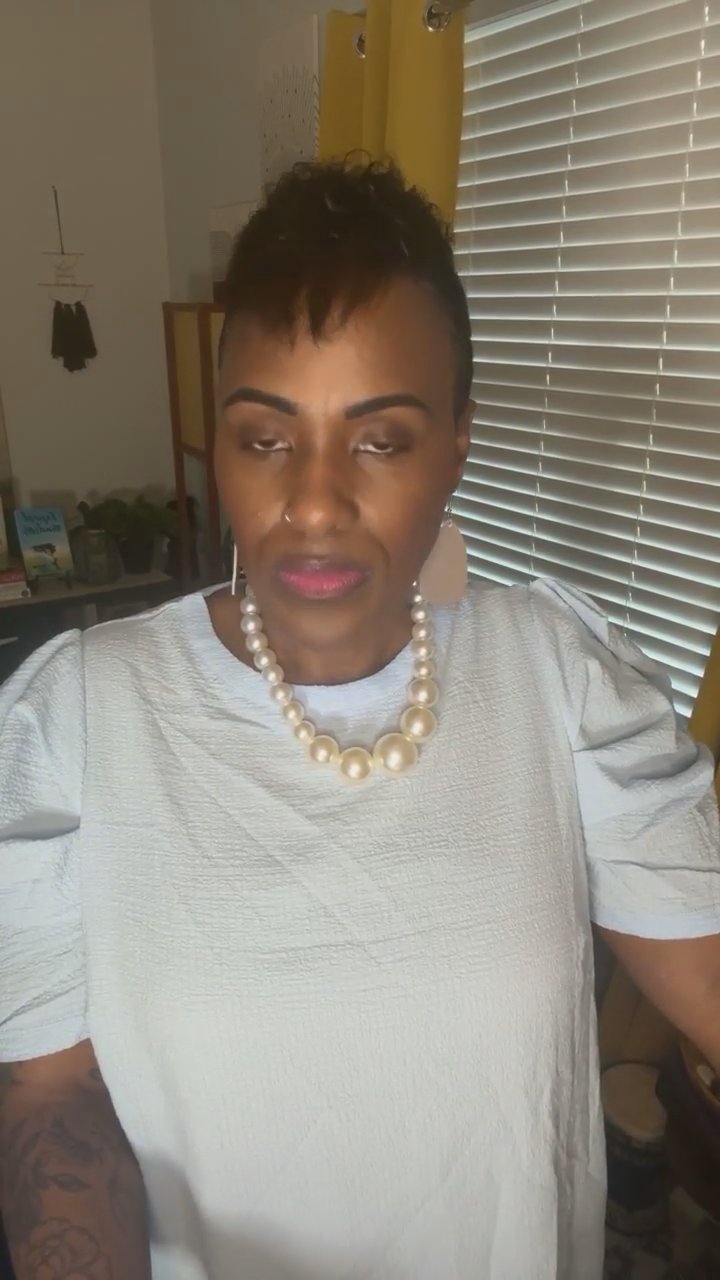
Dr.Charryse provides insight and guidance on how to consciously participate in living a life you don’t need to escape. These engaging and relatable lives emphasize growth mindset, mental health, and the power of choice.
Here on Cadre on Wednesdays, we get into all things mental health and mental well being. I'm all about you finding the balance between the peace and the harmony that you need. Make sure you're sharing this with someone, because we all need to do a little work in our lives.
We typically start two ways. Number one, rate your week. You decide what a ten is for you based on the context of your life. And you are giving me where you are in the world so that we all feel like we're together.
Neil York: You want to find the line between being the helper and the rescuer. When people expect you to be the rescue, that is a form of manipulation. The helper also gives only what is needed.
Audrey, my challenge is that I fiercely push back against getting put into a rescuer role. Sometimes we're already helping in so many areas that we don't have the capacity to take on others. I have this checklist that I use with clients to remind yourself that you are likely helping in other ways.
If you scored more than ten points, you are on the line of rescuing being a possible motive. Next week we'll talk a little bit more about if you are the rescuer and how to move from rescuer to helper. Have a good week.
Hello, my loves. Those of you who are in the Cadresphere, sorry if you don't want to be called love, but in all the appropriate ways, that is how I want to start this moment. I missed you guys last week, but I had a phenomenal time in London, through Charlotte, through Greenville, through all the things. Good morning, Andrea. And I hope that you took care of yourself last week. And wherever you are and wherever you find yourself in this moment, know that you're in the right place, because here on Cadre on Wednesdays, we get into all things mental health and mental well being.
So this is an opportunity for you to sink in and get a little nugget that might be helpful for you now or in the future. We typically start two ways, but before we do, let me say if this is your first time here, I'm so glad you're here. I'm doctor Charryse Johnson, a licensed clinical mental health therapist, mindfulness practitioner, and author. And I'm all about you finding the balance between the peace and the harmony that you need. If you're willing to do the work. As a matter of fact, make sure you're sharing this with someone, because we all need to do a little work in our lives.
Hello, Ken. Hello, Joyce Lynn. Hello, Beth and Cindy. We typically start two ways. Number one, rate your week. I feel like this week flying by. So, scale of one to ten, how you doing? You decide what a ten is for you based on the context of your life, and then, of course, tell me where you are. It would have been kind of cool if I did this while I was in London, but it was 5 hours ahead, and that wouldn't have worked. Hello, northern Minnesota. I think I saw South Carolina in the house. And we'll see who else is representing.
Of course, Charlotte is here. And then I'm gonna prep you for what we're going to focus on today while you're giving me your rating. Hello, from Charleston. And you are giving me where you are in the world so that we all feel like we're together. I would have coffee today, but I had so much coffee in London and when I came back that I need to pull back so that I can sleep again. Hello, Fayetteville. Hello, Columbia. So I want to talk about the difference between being the helper and the rescuer, and here's why that's important.
We, as humans, often want to be kind and caring and helpful. There are certain situations in your life. There are certain vocational responsibilities in your life that require you to be maybe even more of a help than you naturally would be. And there's nothing wrong with that. Hello, Neil York. But you want to find the line between when you're offering help for someone or to someone, versus you're being the rescuer for two reasons. Number one, when people expect. Of course I do, Audrey. Know just what you need this morning.
When people expect you to be the rescuer. Helper. That is a form of manipulation. It is a way that people communicate and manipulate, family included. So you really want to be listening to the people who allow you to help them because you choose to do it out of the goodness of your heart, versus the people who say little things to you that make you feel like, well, you would think that the least you could do is Xyz, after all I've done for you and all this time. And Beth, I had both tea and coffee in London.
I had tea and biscuits daily, zero shame, and then lattes every evening to manage the time zone. So I had both. But really listening to the people that are surrounding you, how they're communicating to you, both verbally and non verbally, and finding the line between you helping them and you rescuing them, because rescuing someone else is a cost for both of you. You enable other people from taking ownership of their own growth and responsibility, and people will let you. People genuinely love to be rescued.
Not everyone, but there are certain types of individuals, and we all have some in our life that love to be rescued. And when you are the rescuer, that is going to come at a significant cost to your mental and emotional health. So let's break it down. The helper. The helper. And when you're in this role, you will do a few things. One, you're gonna listen for a request. And it may not be a request that's directly to you, but it may be someone just expressing a need. You listen, you hear it. You present an offer, you decide, oh, I did hear that person say they needed this, and I happen to have time.
So while I'm going to the store, let me, you know, see if they need anything. So you determine when you are in the. The healthy role of helper, what you want to present and what you want to offer to them. But your offering out of the goodness of your heart versus the guilt of your heart, the helper also gives only what is needed. So I want you to notice if you're the kind of person that you also have a tendency to feel like you need to do more and more and more, and that what you give is not enough, and then the helper.
And this is key is going to check the results of the help that they're giving. Is this person functioning better? Are they meeting their own goals? Are they solving problems independently? Help means you're coming alongside of someone else and you're helping them in the process of them already helping themselves. If they're sitting back and waiting and expecting you to do things for them, they are manipulative in some form of fashion, and people can be lovingly manipulative. Family is a big one, and then they're expecting you to rescue.
So when you're being a rescuer, rescuer whether asked or not, here's what that might look like. If you're in the role of rescuer, you are giving when not asked. So that might also mean that this individual or this system has manipulated you to the point that you spend a lot of time thinking ahead of. What can I already go ahead and give them so that it's covered? Or you're trying to think of what they need before they ask to keep some level of confrontation away. That means some level of manipulation and rescuing is in place.
The rescuer also neglects to find out if the offer is welcome. So this is for those of you who just love going around rescuing people. And you're like, but I'm. I'm so nurturing. I'm such a caring person. I'm such a caring dude. That's fine, but also be careful because we can rescue at the expense of rescuing ourselves. Number three, a rescuer gives help more or longer than needed. Are you the type of person, or are you in a situation where you're continuing to do something that you're like, I'm really tired of doing this.
I don't even know if this person really needs it anymore. But you either can't stop because you're afraid of their response, or you can't stop because you would feel bad if you weren't there for everyone. And I won't get into for the sake of time. But there's an undertone of trauma in some aspects that can be in place when we've been the rescuer. Some of you may find that that's been your kind of family archetype and role that as the oldest or the only or the oldest son or whatever the dynamic is, you have almost been taught that's your job.
It's not. It is not your job to rescue everyone in your life. People are capable of helping themselves, even when they act like they aren't. Q. Virtual sip other things that a rescuer do will do, or you will do when you're in the rescue mindset is you're not going to check on the results of another person. You're not going to be concerned about how independently they're functioning. You may find that being the rescuer does something for you and makes you feel needed, gives you a sense of worth. And the challenge to that is when you're in that mentality and that mindset and you are operating in that pattern, you will often stay the rescuer longer than intended at the expense of rescuing yourself or focusing on yourself.
You can really feel depleted in ways that you're not intended to be. And by nature, we find that a lot of rescuers don't have boundaries. That's a good caveat between what's the difference when you're being a helper and you're being a rescuer. When you are a helper, you are extending what you have available to give with boundaries, and those boundaries are not connected to guilt, and that can happen, and it's not bad. Audrey, great thought. For those of you who might just be listening to this, she's saying that my challenge is that I fiercely push back against getting put into a rescuer role.
Excellent. That's not a bad thing because we are not designed to consistently play that role. Even if we are ministers, caregivers, we still want the person that we're caring for to stay as independent as possible for their own support and health. And it's important, depending upon who you're pushing against, to really resist that. I too have some people in my life who would love for me to play rescuer and will constantly say things to try to guilt me into rescuing them in ways that they would like.
And I'm fiercely strong because I understand that if I take on the role of a rescuer, fellow rescuers who are, that's you listen, then you are in a situation where they're not helping themselves. Whether or not it's at the expense of helping someone. I think that's where you can learn to trust yourself again. I'll just use myself as an example. Not that I'm perfect, but just because I'm not talking about other people and their lives. When you want to help, and you can stop and think about that if you're afraid that, okay, am I not helping someone?
Am I pushing back at the wrong time? I just want you to consider where all the other places that you are being a helper. Because sometimes we're fiercely pushing back against being a rescuer because we are already helping in so many areas that we don't have the capacity to take on others. And then you can also, with that same person or that individual, you can decide, do I want to help them? And in what ways do I feel like I'm willing to help them? That isn't going to create this expectation. But if you have someone in your life, and this is not, you know, centered towards Audrey, but everyone that is an emotionally manipulative person, your boundaries have to stay consistent.
They have to stay very clear. And the level of help that you can extend to someone who gaslights to someone who is very self focused and self centered is different than what you can give. There are some people that if you help them, that becomes an entitlement for them. So you want to take it a case by case basis, but also remind yourself that you are likely helping in other ways. So I actually have this checklist that I use with clients, and I want to walk you through it. It's called the rescuers checklist.
And what you want to do is we're going to mark on a scale of zero to 20 means seldom or never. One is sometimes or occasionally, and two is frequently. So completing this checklist can help you be aware of ways you may be rescuing people without realizing, I'm going to make a statement. You then score yourself zero to two. And then if I say the word x, that means that I'm talking about a spouse, a boss, a parent, a friend or colleague. It's just, you know, a fill in. All right, I'm gonna read through these.
It is hard for me to take time for myself and have fun. Don't overthink it. Seldom or never. Sometimes or occasionally. Or frequently. Zero, one or two. Next one. I supply words for ex, whoever that person or situation is. When he or she hesitates, I set limits for myself that I then exceed. Oh, I know that. Read somebody's mail. I know it did. You don't even have to tell me. I can feel it. The next one. I believe I am responsible for making or keeping x happy. And tell me if I'm going too fast.
The next one. I enjoy lending a shoulder for x to cry on. The next one. I believe that X is not sufficiently grateful for my help. I take care of X more than I take care of myself. I find myself interrupting when x is talking. I watch for clues, for ways to be helpful to X. We're about halfway done. I make excuses, openly or mentally for X. I do more than my share. That is, I work harder than xdev. When X is unsure or uncomfortable about doing something. I do it for X. I give up doing things because x wouldn't like it.
I find myself thinking that I really know what is best for X. I think X would have grave difficulty getting along without me. I use the word we and then find I don't have X's consent. I stop myself by thinking x will feel badly if I say or do something. It is hard for me not to respond to anyone who seems hurting or needing help. All my people, please stand up. I find others resenting me when I was only trying to be helpful. Got two more to go. I find myself giving advice that is not welcomed or accepted.
That was the last one. So, total score. I'm gonna give you a moment to tally it up and then I'll tell you what the score ranges mean and I'm still within my 20 minutes. If you scored more than ten points, you are on the line of rescuing being a possible motive. If you scored more than 20 points, you would be identified as a rescuer and you have some work to do. Now, next week we'll do a part two of this and I will talk a little bit more about if you are the rescuer, how to move from rescuer to helper, and some typical excuses that you may make around being the rescuer.
You might want to go replay this because again, remember that X was boss. Parents, friends, colleagues, life where you work and you might have surprised yourself on the score. But until then, I hope you have a phenomenal rest of the week. Continue as you go throughout the week between now and the next time we're together to notice and pay attention to your rescuing tendencies or helping tendencies. Why do I believe that my help is absolutely necessary in this situation? And can I be okay if I step back and allow this person to help themselves until we meet again?
Have a good week. I'll see you on Friday.
Reactions and comments are for members. Joining is free and takes a minute.