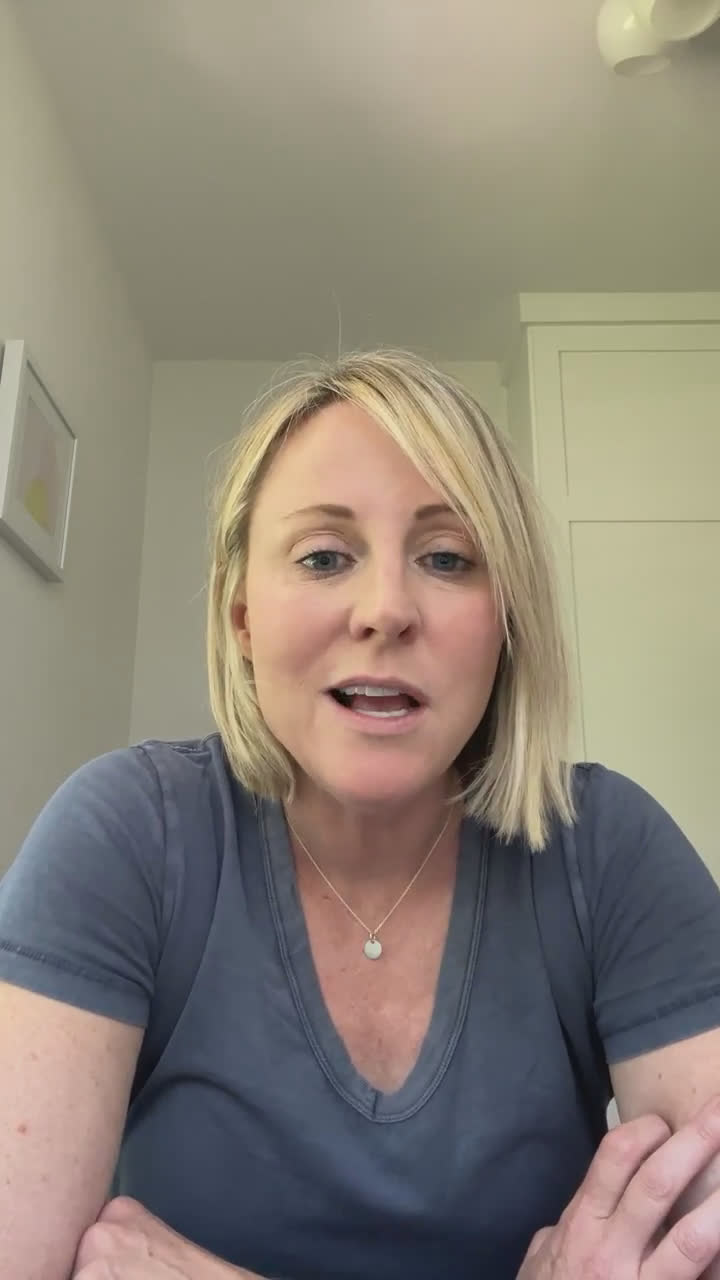
Shannon shares five steps from her lived experience with CPTSD and family estrangement, describing how grief shows up in familial relationships and walking through step four of her process for moving out of survival mode.
Cadre, happy Friday. I'm a little bit late to this live stream. I had a technical issue. So, actually, I'm moving this back. Happy Friday.
Shannon: I am a human with lived experience here today to talk to you about grief and how that manifests in familial relationships. She has lived experience as someone with CPTSD, generalized anxiety disorder, and someone who parents a child with autism. Here are five steps to dealing with grief and family.
"I had a meeting with my therapist this week, and she said, hey, we need to check on progress. And I was shocked and honored and thrilled to see that in the time that I've spent working on this, particularly the CPTSD piece around my family, I'm like, 85% good, right? "
LZ: How do you stop living in survival mode if you haven't watched the other ones? LZ: My mom is not the mom I needed. Step two was to say it out loud. Step three is to notice. Step four is imagine a world where blank x can exist.
Cadre, happy Friday. It is Shannon from Cadre. I'm trying to move this to be in a good spot. Hi, guys. Happy Friday. Okay. Sorry for the bumpiness there. I'm a little bit late to this live stream. I had a technical issue. My bad. So, actually, I'm moving this back. Good afternoon. Hi. Welcome to a grief day on Cadre. For those of you who don't know who I am, my name is Shannon. I am a human with lived experience here today to talk to you about grief and how that manifests in familial relationships.
I am part of the Cadre team, actually. So for those of you who have been around, I lead operations at Cadre. I know some of you really well. I'm grateful for you to be here, for you being here, rather. So today, I am going to talk about what I have learned as a human who is not a clinician, who is not a mental health professional, who has lived experience as someone with CPTSD, generalized anxiety disorder, and someone who parents a child with autism. And so today, you have caught me in step four of a series I've been doing on grief and family.
And so, for those who don't know, I have a challenging family relationship, honestly, with a lot of people, my family, particularly my mom. And so I'm talking. I've been talking a bit about what that means and how that manifests for me, what I've learned in the seven years I've spent in therapy about how to manage it. And so I took all those learnings and put them into five steps, and I'm sharing them with you. And I call it how to stop living in survival mode. For me, that's what it feels like.
That's what it has felt like in the past. And before I go into step four, I briefly want to tell you something exciting that for any of you who have worked through things like this, will appreciate. I had a meeting with my therapist this week, and she said, hey, we need to check on progress. It's been a bit. To be fair, this was a 2020 treatment plan that we needed to update. So it's a good four years of work. So I will say that. But as we went through the things that were the impetus for me being in therapy when I started in 2020, and a big one of them for me was the CPSD piece, with particularly my mom.
But honestly, my entire family system, as we went through all of it and went through my progress, and for those of you who know how it goes or who don't, essentially, it's fairly simple. Like, is this a thing for you still? How big of a deal is it? How much does it impact your life? And I was shocked and honored and thrilled to see that in the time that I've spent working on this, particularly the CPTSD piece around my family, I'm like, 85% good, right? We talked through it, and she's like, listen, you're getting the skills.
And so in a year, maybe, right? Like, there's not even a time. Let's be honest. There's not even a time. But I'm getting to the point where I may not even meet that criteria anymore, which is amazing and insane and essentially means that these things I'm talking to you about today, again, from my own experience, help me get better. So that's some great news and sort of the real life implication of the things I'm talking to about. All right, so today we're on step four of how do you stop living in survival mode if you haven't watched the other ones?
One, two, and three are, no, no, something is not right in your life. And typically, how that manifests, or manifested for me, was what I was thinking, believing, feeling on the inside was not matching how I was showing up in the world. For me, again, with my mom, that meant that my relationship with her was not authentic. I was doing a lot of pretending that I was okay. So I had to notice that was happening. Step two was to say it out loud. That's a big step. You can go back and watch that live.
It's a big one. But what it really does is it manifests that there is a different way than what's happening in your brain and your body to be right. And so mine was. My mom is not the mom I needed. So that's step two, saying it out loud. And that can take a really long time. Right. Step three, then, is to notice. So now I know this new thing. I said it out loud, and now I notice, like, oh, wow, I have a different story. I have a different narrative. Notice how that feels. Notice how it feels in your body.
Notice how it feels in the relationships. And then today, step four is imagine a world where blank x can exist. So what if this new thing that you know is true that you said out loud that you now are noticing feels different when you live it? Right? If my mom wasn't the mom for me, how does that. How is that different then? How does that shift how I feel when I'm in a room with her? Right? Do I blame her less? Do I blame myself less? Is it more about grace and love? Right. So all of these things.
And then step four is imagine a world where, like, that's just the world. That world exists, this new world, where, oh, my gosh, I can feel this way all the time. So there's a permanence to it. There's a tangibility to it to say, like, I can start to live in this new space where I feel less shame, where I feel less like it was my fault, where I feel like I don't have to blame my mom, where I don't have a headache or I'm not so anxious. Right. And living in that new world has implications, because that new world also will look different than your own world.
So why that lives on grief day is that. Again, as with every step in this process, there's grief potentially associated with that. So if I have a new world, and this is the truth, my new world that exists is that I don't spend time with my mother in the way that I felt like I was supposed to before. Do I still interact with her? Yes. Do I do it on the terms that work for me? Yes. Why? Because in this new world, it's okay. That that's how we do it. Because in this new world, no one is at fault. And what works for me in my new world is a different.
Is a different way. If you've ever watched my friend Colleen Lindstrom, you will hear her say, boundaries are the distance at which I can love you and I can love me. And I think when we're building our new worlds and imagining these new worlds that can exist, that's sort of the. That's like our. That's like our blueprint, almost, right? Is what do I need to love you? What does that look like? What structure does that take on? Right? And what do I need to love myself? What walls do I need to put up for that?
Or maybe it's not a wall. Maybe it's a. You know, maybe it's a door, like a swinging door. I don't know. I have some weird architecture analogy happening here. But you get it, right? What are the things that need to be part of that new world so that you can love yourself and be okay? I'm gonna even substitute love that person with be okay, because in your new world, love might not be a word you're ready for yet, and that's totally fine. And you know what? You might never be ready for that word in your new world.
But if you start to see that it can exist and you start to envision it. You're gonna move a step closer to it and a step closer to it, and it's gonna get more comfortable, and you're gonna start to live in it, and then all of a sudden, it's going to be where you live. And thank you, Jules, for the high five, because I feel like that is what happened in my life, was that I created the new world to live in, and now I'm living in it, and it's better. And I know you guys can all do it, too. And I know that whatever works for you, whether it's this process or whatever it is, showing up for any of this work, showing up to say anything out loud when it comes to familial relationships, is hard.
It is hard. It is so freaking hard. And so I just honor you for being here and being able to even think that this is something that you're dealing with, because it can hurt, and it can be painful. It is. It is hurtful and painful. And I think, as I said in my other video, saying things out loud that hurt and sitting with that can take a really long time to grieve. So thank you. Not even thank you, but, yeah, thank you. Thank you for being a person who does this work, because we're building a better world where we are loving ourselves and we are loving each other, and we're doing it in a way that works for us.
So that is it today, my friends, I am so glad you're here. Thank you for being here. You make my life better. Thank you for being here in the Cadre sphere. Marigold is coming up pretty quick here with more on grief, but Cadre is always here for you. I am always here for you. And thank you for being a part of this world where we make each other feel better. Have a fantastic weekend, everybody, and we will see you next week in the cadres.
Reactions and comments are for members. Joining is free and takes a minute.