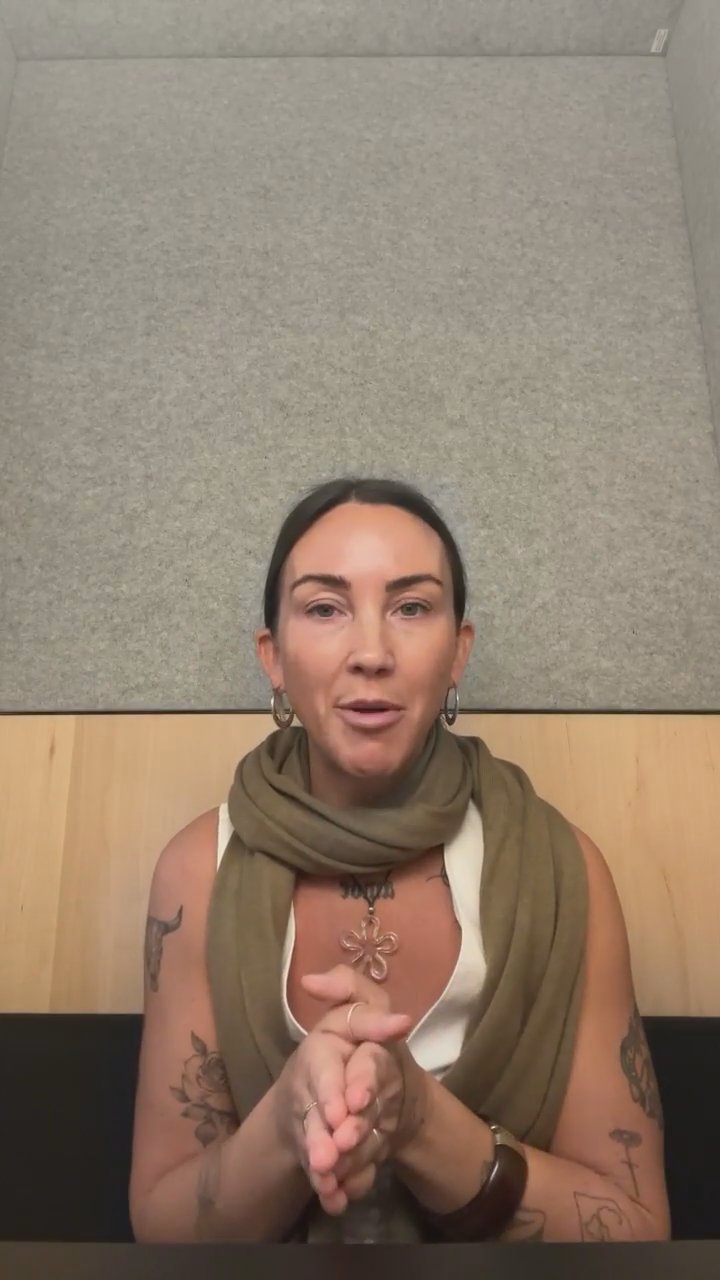
Rachel reflects on joining a coworking space to make friends, discusses how familiarity and repeated presence can spark connections, and explores the challenges of building authentic adult friendships and asking for the kinds of relationships one wants.
I just joined a co working space in an effort to make friends. Making new friends can be really, really overwhelming. Not every friend is going to be my best friend. We have many friends, and they provide us with different reasons for friendship.
Rachel says if we want certain kinds of relationships, we have to ask for them. Relationships are about meeting in the middle, she says. Rachel says she hasn't had a true friend since she was ten.
Being in the same place over and over, that familiarity really, really helps to create an initial contact. Because familiarity creates safety in the brain, which creates a higher likelihood of potentially making a connection. Have a beautiful rest of your day.
Happy Wednesday, Cadre crew. I am coming to you today from Rachel's tiny room. I'm in a little, like, call room. I feel like I'm in the future. I just joined a co working space in an effort to make new friends. So today my live stream is coming to you from one of their little mini call rooms that they have, which is not as cute as my. Hi, Russell. Hi. I was literally just working on your book. Hi, Rachel. So if you're just joining, I'm letting y'all know I'm in a tiny little, like, call space today because I just joined a co working space in an effort to make friends and meet people while I'm, you know, engaging in my daily work.
Because I work from home, so I'm able to work remotely. And I've noticed that on days when I go work in a coffee shop, my mental health symptoms are so much lower. Like, if I sit at home all day doing my work, I'm anxious, I feel sad, I feel less motivation, I struggle more to get my tasks done, and I generally just start to have thoughts of, like, I'm not doing enough, or. And then I also will get over. I'll overthink my own actual relationships of people not texting me fast enough because I'm just by myself.
And so I've found that when I'm in coffee shops, I don't experience that as much because I'm around other humans. And so I decided to join a coworking space because not only am I then around other humans who are also working, but I'm seeing similar faces every day, which is a really wonderful way to start actually building connections and potentially making friends. So I also had a really lovely conversation with someone yesterday about building friendships as an adult, specifically building friendships that are not surface level and where you can show up authentically, you can show up and talk about your mental health, you can show up and feel like, I don't have to put on a mask in front of these people.
We were talking about the challenges of doing that and how easy it feels to do online, but how hard it feels to do in person. So I wanted to talk about this today because it felt. It just felt relevant. So if you struggle to make friends, me too. It is not something that is uncommon. And especially if you are an adult or if you are living in a new city or if you've just gone through a big transition like a new job or a new relationship, making new friends can be really, really overwhelming, and it can also trigger a lot of our old insecurities.
So when we start to make new friends, not everyone's gonna want to be our friend. And that doesn't mean that there's something wrong with us or that we're not likable or lovable or worthy of friendship. It just means people might not be in a time in their life when they are looking for new friendships or our values are different, or someone simply doesn't have time to put in the effort to cultivate new relationships, and it can still create in ourselves some of those stories around, I'm not lovable, I'm not good enough, I'm not smart enough, I'm not funny enough, I'm not cool enough.
Whatever it is, it's also challenging if we experience social anxiety to put ourselves out there in social situations to try and meet people. So I have learned over the last many, many, many years a lot of different skills and tools for building friends. I moved a lot when I was a kid, and I have traveled a lot as an adult. And then I got divorced about four years ago and basically started from scratch socially. So I have a lot of experience with meeting people and building, building friendships on all kinds of levels and in all phases of my life.
And I think one of the first, most important things I learned is that not every friend is going to be my best friend. I used to put so much pressure on new friendships that they needed to be or become, like, my absolute best friend or even someone that I spent a lot of time with. And if it didn't develop into that, I immediately decided that they actually just weren't my friend. And I've learned that friends come in seasons, and also there's a spectrum of what it means to be somebody's friend. So I have friends that I see once a month, and I have friends that I see a few times a week.
Both of them are my friends. It doesn't mean that one of them is better or worse. It just means that I see them at a different frequency and in different places in different times. And that's okay. That's the beauty of friendship, is we have many friends, and they provide us with different things for different reasons. I had someone tell me, a friend actually tell me a couple years ago. She was like, yeah, Racha, I have friends for different things that I go to when I need different things. And at first I heard that, and I was like, well, that's selfish.
You just need something from someone, and, you know, you can get it from that person. And she's like, no, what I mean is, like, I know that if I need to talk to someone about something serious in my life or about something I'm going through, that I feel vulnerable sharing. There are certain people that I. That I trust with, with that in my life, and there's others that I don't. It doesn't mean that that other person isn't still my good friend. It's just that I know that this person can help me with this kind of thing.
Whereas if I want to go on a trip for five days and be spontaneous and wild, I'm going to ask this friend to go with me because I know that that's the kind of person that I can do these kinds of trips with. And so she helped me reframe that. Not all friends have to be everything for me all at once, nor do I have to be everything for all my friends all at once. So that took away a lot of pressure for me when I started engaging more with new people around, expecting them to become everything for me and reminding myself that people are different and they have different things to offer, and we're going to connect on different levels.
And so it's okay for not every single friend to be my best friend. So that was one thing that was really helpful for me, is relieving that pressure. And then the second, the second thing that has been helpful is just figuring out the mechanism of how. Okay, well, how do I actually meet people? Right? Like, this is lovely in concept, but how do I actually meet anyone? So it might seem very simple because it is. But just because it's simple doesn't mean it's easy. But physically putting yourself in places where there are other human beings who share one common interest.
So that might be going like, for me, I love karaoke. So I go and I sing karaoke Wednesday nights, and I know that people that are there also like to sing karaoke. They probably also like to hang out and have a couple cocktails on an evening. I know that they probably also like music and performing and being extravagant. And these are parts of myself that I want to be able to share with other people. So I'm putting myself in a scenario where there's other people who have similar interests as me. And by repeatedly showing up in those places, I start to see some familiar faces.
And when we start to see familiar faces, that creates opportunity to make a connection. So if I go sing karaoke every Wednesday and I start to see the same, maybe there's the same group that's there often, or maybe it's the bartender I see often, I can start to then ask these people, like, hey, I've seen you here a lot. What's your name? I always see you. It'd be nice to say hi, right? I don't have to immediately be like, and do you want to be my friend and hang out? I make a small connection so that there's a familiarity and a point of reference, and there's that continuation of seeing this person over and over.
And that might not create a huge dynamic or relationship with that particular person or set of people. But what it does is it creates windows of opportunity for other connections. So if I see the same group of people every week and I start to know them by name, maybe one week they bring a friend and introduce me to them, and I hit it off with that person. Or maybe one week they say, do you want to sit with us this week? And I sit with them and I engage with them, and they invite me to go do something else.
Who knows what it is? But having those little small connections in places that we frequent, that we have something that we like and that we want to be able to engage with other people with, can create these micro connections that maybe lead to something else. And if they don't lead to something else, there is a lot of research that shows that having these micro connections, or simply like knowing your barista when you go get your coffee, creates the same fulfillment and regulation for the nervous system as having a meaningful long term friend.
So it provides us with that same sense of regulation, which is what is so great about human beings and being around people. And let's see, what was the third thing? I thought I had a third thing. Maybe I forgot. Maybe there wasn't a third thing. I think those are the two big things. I think, you know, the other thing too, is like, oh, this was the other. Yes, I had third thing. I always have three. So the third thing is, you know, reminding ourselves that if we want certain kinds of relationships, then we have to.
We have to ask for them, right? So if I want a kind of a friendship where I can share things that are hard for me to talk about, or I can talk about my feelings or have conflict or whatever it is that maybe feels scary or vulnerable, I can't expect the other person to be the only one to offer it to me. I have to offer it too. So if I want someone to ask me hard questions or get to know me on a deeper level, and they're not doing that, I have to also ask myself, well, am I asking them those questions?
Am I trying to get them to know them on a deeper level. Am I initiating the kind of relational dynamic I want, or am I just hoping that they'll do it for me? So I also have to remind myself relationships are about meeting in the middle, right. And so if I want to meet someone in the middle, I have to come halfway as well, instead of waiting over here hoping that they're going to come invite me. So it's a little bit of, like, I'll move towards you. Will you move towards me too? And if there is movement towards me again, then we move a little bit closer and closer.
Right. But if I'm constantly moving towards someone and they're not meeting me, then that's also an opportunity for me to say, like, is this a friendship that I want to take to that level where we have that closeness? So kind of assessing the give and take dynamic. Okay, let's look at some comments here. Rachel says, looking back, I realized I haven't had a true friend since I was ten. And for a while in high school. That's rough bb. That's rough friendships. Yeah. I've been through periods where I don't.
I just don't have, like, a, like, a really solid friend. And that's hard. You know, I've had friend breakups. I've moved. I've, you know, just gotten older and life has changed, and it's really hard to be in those seasons of not having, like, you know, a true friend. Can milo come to the shared office space? Yes, he can. They're dog friendly, which is so cool. I haven't brought him yet because I'm worried. I'm worried he might be a distraction or that he might be overstimulated. But I'm gonna bring him on a day when I don't have too much to do so that if it's like, if it doesn't work, we can just leave and see how he does, because that'd be fun to be able to bring him.
I think that'd be cute. So. Okay, my loves, I hope that you have a beautiful rest of your Wednesday despite the darkness in here. It is very sunny in Seattle, which I love, so. Okay, hang up. Rachel says, it seems that people talk about it, but always mention putting yourself out there, just getting out. But for me, that has never resulted in anything. I love that you said to go same place over and over. That's helpful. Okay, good. I'm glad that's helpful. Yeah. Because, yeah, putting yourself out there in, like, lots of different places can feel kind of like I don't know, it makes it hard to really assess.
Like, it's just hard. It means always hard. But, you know, I have found that being in the same place over and over, like, even if I just go work in the same coffee shop over and over, that familiarity really, really helps to create an initial contact. Because if I'm just trying to talk to a literal, random stranger that I've never seen before, my odds of having a connection happen are a lot lower than if I approach someone whose face I've seen multiple times and they've seen my face. Because familiarity creates safety in the brain.
So if I'm a familiar face to someone and they're a familiar face to me, there's a level of safety that we've now already embedded in before asking each other or talking to each other about whatever. Whereas if I talk to a complete stranger, the brain is immediately like, I don't know you, therefore, you might be dangerous. I don't like you're not familiar. So that familiarity actually creates some safety in the brain, which creates a higher likelihood of potentially making a connection. So. Okay, my dears, have a beautiful rest of your day, and I will see you same time, maybe same place.
Might be back in my apartment. We'll see next week. Talk to you soon. Bye.
Reactions and comments are for members. Joining is free and takes a minute.